
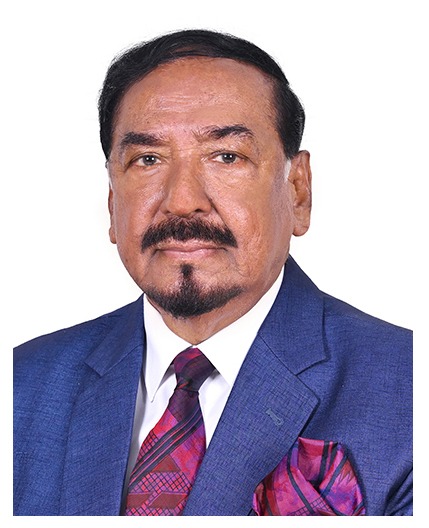
Hafiz Uddin Ahmad Bir Bikram
Honorable President
People’s Republic of Bangladesh
and
Honorable Chancellor
Gazipur Agricultural University
His Excellency Mr. Hafiz Uddin Ahmad, Bir Bikram, assumed office as the 23rd President of the People’s Republic of Bangladesh on 24 July 2026.
Mr. Hafiz Uddin Ahmad, Bir Bikram is a valiant freedom fighter, distinguished sportsman, accomplished military officer and an experienced politician. He is widely recognized both at home and abroad for his outstanding contributions and notable achievements in all these fields. His career trajectory–from serving as a professional footballer in the 1960s to Speaker of the National Parliament in 2026 and, most recently, his assumption of office as the 23rd President of the People’s Republic of Bangladesh–exemplifies unwavering commitment, wisdom, resilience, and lifelong dedication to public service.
Early Life and Education
Born on 29 October, 1944, in Lalmohan, Bhola District, Hafiz Uddin Ahmad was raised in a prominent Bengali Muslim family. His father, Dr. Azhar Uddin Ahmad, was an influential political figure and a Member of National Assembly of Pakistan. His mother, Mst. Karimun Nessa Begum, was a homemaker. Hafiz Uddin Ahmad obtained his Master of Arts degree in Political Science from the University of Dhaka in 1965. His academic background laid a strong foundation for his subsequent political career.
Contributions and Achievements in Sports
Before embarking on his military and political careers, Mr. Hafiz Uddin Ahmad earned considerable distinction as a footballer and was recognized as one of the most talented players of his generation. As a dynamic forward, he played for several prominent clubs, including Mohammedan Sporting Club. He represented the Pakistan National Football team from 1967 until Bangladesh’s independence in 1971. His international participation included matches in Iran, Türkiye, and Myanmar. Between 1964 and 1966, he also set records in the 100-metre and 200-metre sprint events in the then East Pakistan. His athletic prowess, marked by exceptional speed and competitive drive, positioned him as a prominent figure in South Asian football. In recognition of his contributions to football, FIFA honored him with the prestigious centennial ‘Order of Merit’ in 2005, one of the sport’s most distinguished global awards.
Military Service During the Bangladesh Liberation War
During the great Liberation War of Bangladesh in 1971, Hafiz Uddin Ahmad demonstrated exemplary patriotism. As a commissioned officer of the Pakistan Army holding the rank of Captain, he actively participated in frontline combat in several strategically important areas, particularly under Sector 8 and the ‘Z’ Force. He as an officer of East Bengal Regiment revolted against the Government of Pakistan at Jassore Cantonment on March 30, 1971. He fought against Pakistan army for about eight hours and extricated out of cantonment with two hundred soldiers. For his exceptional bravery and strategic acumen, he was awarded the Bir Bikram, Bangladesh’s third-highest military decoration, establishing his status as a distinguished freedom fighter whose sacrifices contributed to the nation’s independence. On 15 December 1971 under the command of ‘Z’ Force commanded by the then Major Ziaur Rahman, he captured Sylhet town after day long battle.
Political Career
Mr. Hafiz was first elected as a Member of Parliament from the Bhola-3 constituency in 1986, subsequently he joined the Bangladesh Nationalist Party (BNP) in 1992. During his parliamentary career, he was elected as a Member of Parliament in the 3rd (1986), 4th (1988), 5th (1991), 6th (1996), 7th (1996), 8th (2001), and 13th (2026) National Parliament elections. Throughout his political career, he held various senior positions within the Bangladesh Nationalist Party and served on its Standing Committee, reflecting his distinguished position within the party. He was subsequently appointed a member of the party’s highest policymaking body, the National Standing Committee.
His ministerial portfolio encompassed multiple key ministries, including State Minister of Commerce (1996), Minister of Water Resources, Minister of Commerce and Minister of Jute (2001-2006), and most recently, Minister of Liberation War Affairs (2026).
In March 2026, he was elected unanimously as the Speaker of the 13th National Parliament of Bangladesh. As Speaker of the National Parliament, he presided over legislative proceedings and provided leadership at a critical juncture in Bangladesh’s democratic development.
Personal Life and Ideology
Hafiz Uddin Ahmad was married to Dilara Hafiz, an esteemed educationist. She served as Principal of Dhaka Eden Girls’ College and Shahid Suhrawardy College, as well as Director General of the Directorate of Secondary and Higher Secondary Education. She passed away on March 28, 2026.
Mr. Hafiz Uddin Ahmad is the father of two sons and one daughter. His son Shahrukh Hafiz is a computer engineer, while his other son, Taharat Hafiz, is a businessman. His daughter, Shamama Shahrin Hafiz, completed her Master of Business Administration degree at the University of Windsor in Canada.
Mr. Hafiz Uddin Ahmad is widely respected for his personal discipline, sporting spirit, military professionalism, political experience and integrity. He remains an ardent supporter of the core principles of the War of Independence, advocating for robust democracy, institutional accountability, national development, and the rule of law. His clear positions on contemporary issues and his candid views have established him as a principled statesman.
Legacy
The distinguished career of Hafiz Uddin Ahmad represents a broad canvas of achievement across diverse fields. He is a FIFA-recognized footballer, a valiant freedom fighter decorated with the Bir Bikram gallantry award, a decorated military officer, a seven-time elected Member of Parliament, an experienced minister and a distinguished former Speaker of the National Parliament.
His current service as President, together with a remarkable career spanning more than six decades, reflects his enduring commitment to national progress. His life and work embody an exceptional combination of personal excellence and public service and constitute a significant contribution to the democratic evolution of Bangladesh.